
Commercial Roofing in Colorado
Commercial roofing across Colorado.
- Free storm damage inspections
- Independent local contractors
- Written scope and documentation
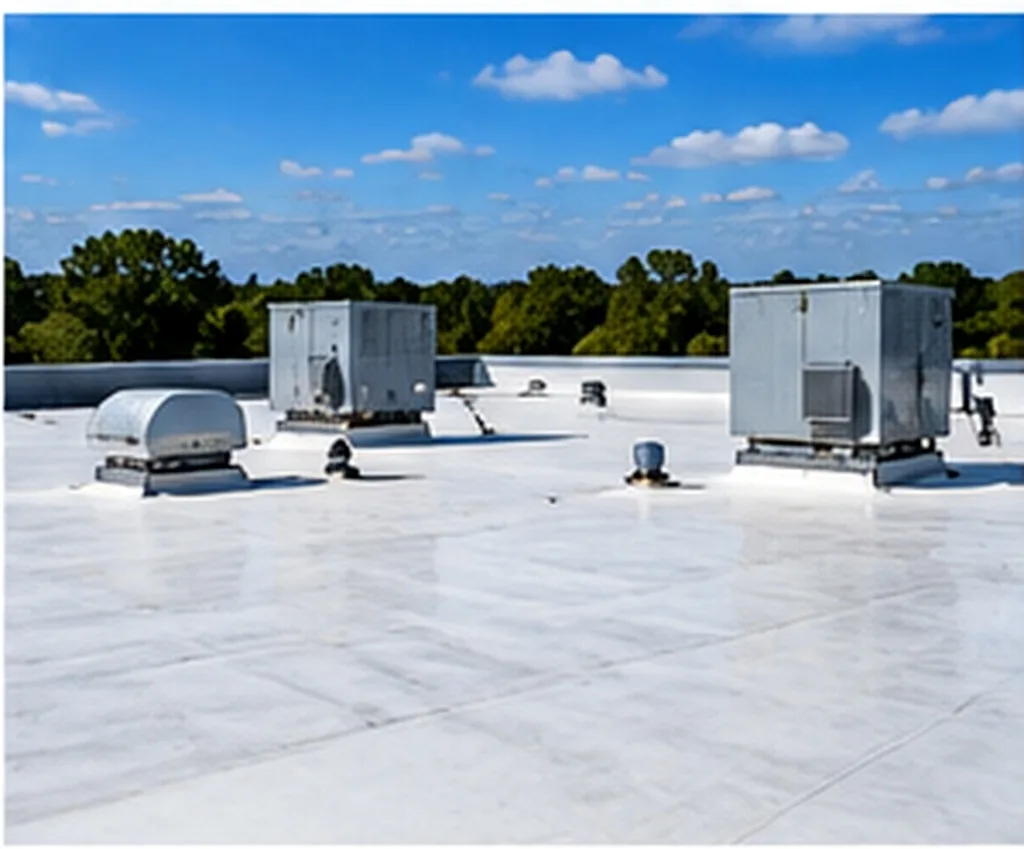
Commercial roofing covers flat and low-slope systems — typically TPO, EPDM, PVC or modified bitumen — on business, industrial, multifamily and institutional buildings. The priorities differ from residential work: drainage, rooftop equipment penetrations, and minimising disruption to building operations.
How commercial roofing differs from residential
The difference is not simply scale. Flat and low-slope roofs work on an entirely different principle from pitched roofs, and that changes what can go wrong.
A pitched roof sheds water by gravity, and the covering only needs to direct it downhill. A low-slope roof holds water for a period and relies on a continuous waterproof membrane plus a designed drainage path. There is far less margin for error: a defect that a pitched roof would tolerate becomes a leak on a flat roof.
Penetrations multiply the problem. A commercial roof typically carries HVAC units, exhaust fans, vents, conduit, skylights and equipment curbs — each one a hole through the membrane that must be flashed and maintained. Most commercial roof failures start at a penetration or a seam, not in the open field.
Then there is the operational dimension. Work has to be sequenced around a functioning business — tenant access, noise constraints, fume control near air intakes, and safety separation from the public. A contractor who does this well plans the logistics as carefully as the roofing.
Commercial roofing systems used in Colorado
System selection depends on building use, roof traffic, rooftop equipment, budget and how long the owner intends to hold the asset.
| System | Characteristics | Typical application |
|---|---|---|
| TPO (thermoplastic polyolefin) | Single-ply membrane with heat-welded seams. Reflective white surface reduces cooling load. The most widely specified commercial system today. | Retail, office, warehouse and light industrial buildings across the Front Range. |
| EPDM (rubber membrane) | Durable synthetic rubber with a long track record. Handles temperature extremes and UV well. | Buildings where proven longevity matters more than solar reflectance. Common on older commercial stock. |
| PVC membrane | Heat-welded like TPO but with stronger chemical resistance, particularly to grease and oils. | Restaurants, food processing and anywhere kitchen exhaust contacts the roof. |
| Modified bitumen | Asphalt-based membrane in multiple plies, torch-applied or self-adhering. Tough underfoot. | Roofs with regular maintenance traffic, and smaller commercial buildings. |
| Built-up roof (BUR) | Traditional multi-ply layered system with aggregate surfacing. Very durable but heavy. | Older institutional buildings and situations where the existing assembly is being matched. |
| Metal panel | Standing seam or structural panel on low-slope and pitched commercial roofs. | Industrial, agricultural and architectural commercial projects. See metal roofing for detail. |
What goes wrong on Colorado commercial roofs
Colorado conditions put particular stress on low-slope systems, and the failure patterns are predictable enough to plan maintenance around.
The problems that generate most commercial callouts:
- Ponding water. Water standing more than about 48 hours after rain indicates a drainage problem. Ponding accelerates membrane degradation and adds structural load.
- Seam failure. Thermal cycling works at welded and adhered seams over time. Colorado's daily temperature range is hard on them.
- Penetration and curb flashing failure around HVAC units and vents — the single most common leak source on commercial roofs.
- Hail damage to membrane and rooftop equipment. Condenser coils and fan housings are frequently damaged in the same storm as the roof, and both belong in the claim.
- Blocked drains and scuppers, which turn a designed drainage path into a ponding problem, often after autumn debris or ice.
- Wind uplift at perimeters and corners, where negative pressure peaks. Edge metal and perimeter attachment are where wind damage starts.
- Damage from foot traffic, especially where HVAC technicians service equipment without walkway pads in place.
Preventive maintenance programmes
This is the clearest financial difference between commercial and residential roofing. On a commercial asset, scheduled maintenance is straightforwardly cheaper than reactive repair, and it is usually also a warranty condition.
A typical programme involves semi-annual inspections — spring and autumn — covering membrane condition, seam integrity, every penetration and curb, drains and scuppers, perimeter edge metal, and the condition of rooftop equipment supports. Debris is cleared, minor defects are repaired before they become leaks, and the whole thing is documented so the building owner has a condition record over time.
That documentation matters beyond maintenance. It supports warranty claims, informs capital planning, and provides a baseline condition record if a storm claim follows. For property managers handling multiple buildings, it turns an unpredictable expense into a budgetable one.
Commercial roofing for Colorado property managers
Decision-making on commercial work is different: there is usually a budget cycle, often a board or ownership group, and almost always a tenant to keep operating. The contractors we refer commercial enquiries to are set up for that.
Practically, that means written scopes detailed enough to compare like for like between bidders, proper documentation for insurance and warranty purposes, work sequenced around building operations, and the licensing and insurance levels commercial projects require. Colorado has no statewide roofing licence, so commercial contractors are licensed by the jurisdictions they work in — a relevant question when you have buildings in several municipalities.
We handle commercial enquiries across the state, with the greatest contractor depth in the Denver metro area and along the northern and southern Front Range. If you manage property in more than one market, say so when you call our Colorado roofing referral service and we will try to match you with contractors covering multiple jurisdictions rather than coordinating several separate relationships.
Whichever situation applies to you, the starting point is the same: an inspection from a contractor who can legally work at your address. We connect property owners with our Colorado roofing referral service across all fifty cities we cover, matched by jurisdiction rather than by whoever happens to be nearest. If you are weighing this service against another option, our overview of commercial and residential roofers in Colorado sets out everything we help with.
Commercial Roofing — common questions
How long does a commercial roof last in Colorado?
It depends heavily on the system, the installation quality and whether it has been maintained. Single-ply membranes typically carry manufacturer warranties measured in decades, but Colorado hail and UV exposure mean real-world service life tracks maintenance closely. A maintained roof substantially outlives a neglected one of the same specification.
Can a commercial roof be restored instead of replaced?
Often, yes. Coating and restoration systems can extend the life of a membrane that is ageing but structurally sound, at lower cost and with less disruption than a tear-off. The membrane has to be in suitable condition — restoration over a failing or saturated roof wastes the investment. An assessment determines whether it is a viable option.
Will my business have to close during roof work?
Usually not. Commercial roofing is normally sequenced to keep buildings operating — working in sections, scheduling noisy or fume-producing work outside business hours, and managing access routes. Discuss your operational constraints at the quoting stage so they are built into the schedule rather than handled as problems later.
Is hail damage to a commercial roof covered by insurance?
Commercial property policies generally cover hail, though terms, deductibles and any exclusions vary considerably more than on residential policies. Many carry separate wind and hail deductibles. Document damage to rooftop equipment as well as the membrane — HVAC units are frequently damaged in the same storm and belong in the claim.
How do I compare commercial roofing bids?
Make sure they cover the same scope before comparing price. Check the specified system and thickness, insulation R-value, how many layers are being torn off, what perimeter and edge detail is included, how each penetration is being flashed, and the warranty type — manufacturer system warranties differ substantially from contractor workmanship warranties. A cheaper bid is often a thinner scope.
Commercial Roofing across Colorado
We connect property owners with contractors offering commercial roofing in every city we cover. These are our busiest areas for this service:
See all 50 Colorado cities we cover →
Related roofing services
Get a free commercial roofing quote
Call and we will connect you with an independent local roofing contractor covering your area.
(720) 791-0495Mon–Fri 7am–7pm · Sat 8am–5pm · Sun 9am–4pm (MT)